Jesus’ Boldest Statement!: Who Do You Say I Am?: Matthew 16:13-20
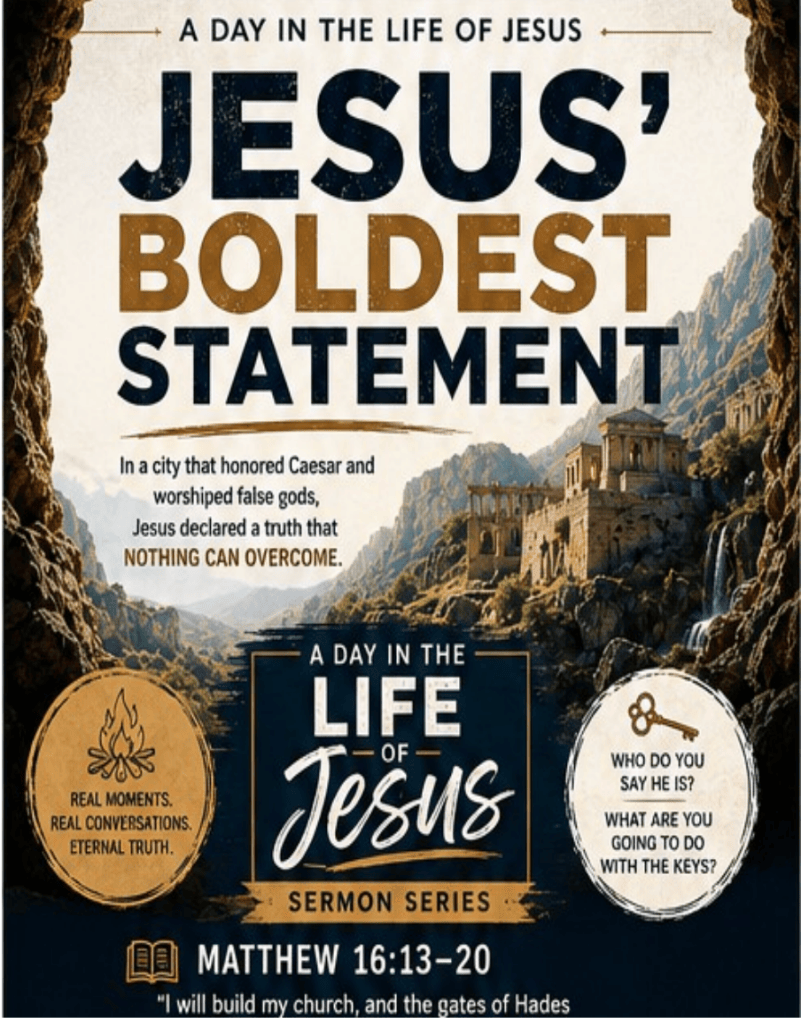
Chapter Four
Sermon Title: “Jesus’ Boldest Statement”
Matthew 16:13–20
Scripture and Sermon
I hope you are enjoying our sermon series “A Day in the Life of Jesus”. I realize that narrative preaching is a little bit different. Thank you for allowing me to be creative in the ways I bring the message. You all are the best and I am so thankful to be your pastor. With that said, let’s look at another day in the life of Jesus from Matthew 16:13-20. May God’s Word speak.
13 When Jesus came to the region of Caesarea Philippi, he asked his disciples, “Who do people say the Son of Man is?” 14 They replied, “Some say John the Baptist; others say Elijah; and still others, Jeremiah or one of the prophets.” 15 “But what about you?” he asked. “Who do you say I am?” 16 Simon Peter answered, “You are the Messiah, the Son of the living God.” 17 Jesus replied, “Blessed are you, Simon son of Jonah, for this was not revealed to you by flesh and blood, but by my Father in heaven. 18 And I tell you that you are Peter, and on this rock I will build my church, and the gates of Hades will not overcome it. 19 I will give you the keys of the kingdom of heaven; whatever you bind on earth will be bound in heaven, and whatever you loose on earth will be loosed in heaven.” 20 Then he ordered his disciples not to tell anyone that he was the Messiah.
Andrew here again. I have talked a lot about Jesus’ amazing acts the past few weeks like the healing of the Canaanite woman’s daughter and the walking on the water but Jesus’ teaching was just as amazing. He really turned everything upside down. For instance, in his famous Sermon on the Mount, Jesus told us that if someone slapped us, we should turn the other cheek. He wanted us to bless those who persecuted us and sin was no longer just actions but our thoughts and intentions.
Jesus set an impossible bar but I think that was his point. Without God’s help, there’s no way we could be the people He wants us to be. So I was glad that your pastor wanted me to tell you about a famous discussion we had with the Lord. His teaching on this matter still challenges me. I believe it was Jesus’ boldest statement which is saying something.
But as I often do, I want to give you the setting of where this took place. As you know from previous Sundays, the crowds were getting larger and larger, the more miracles Jesus performed. The religious leaders were also hounding us at every turn. The crowds and the critics made discipleship difficult.
With this in mind, Jesus took us to another city where most of the inhabitants were pagans. Now Caesarea Philippi was technically still part of Israel, but a couple of decades before our Lord was born, it was given to Herod the Great by Caesar Augustus. In honor of this gift, Herod built a temple of white marble so that people could worship Caesar. When Herod died, the land was given to his son Philip, who actually changed the name of the town to Caesarea Philippi or what some of us like to call “Caesarville”. This was a place where Caesar was honored, pagan gods were worshiped, and very few people were looking for the Messiah of Israel.
As you can imagine, most Jews didn’t plan their vacations to Caesarea Philippi. The Jews that were there kept a pretty low profile. They had three temples in the city, one to Caesar, one to Pan and one to Zeus. Gentiles from all over the world would come to Caesarea Philippi to worship. It was the center for pagan worship in my day. The temples were open twenty four hours a day.
For Jesus, this was the perfect place to spend time investing in us and teaching us about what was to come. The crowds were minimal. To be honest, though Jesus was still popular in most towns in Galilee, Caesarea Philippi was the one town that we could almost go unnoticed. Personally, I would have rather stayed closer to the towns around the Sea of Galilee. Making the 25 mile trip straight north wasn’t fun but it was nice to have quiet time with the Lord.
So the first evening in Caesarea Philippi, Jesus gathers us around a campfire just on the outskirts of the city. And He asked us this simple question, “Who do people say that I am?” Now this caught us all by surprise. Jesus had never once cared what others thought about Him. He didn’t mind ruffling anyone’s feathers. He spoke the truth in love. Jesus was so confident in who He was and what His mission was that we never thought He cared what people were saying. So it took us a moment before anyone spoke up.
Then of course, my brother Peter piped up and said, “A lot of people think you are John the Baptist raised to life” which made absolutely no sense since John baptized Jesus. But this was a rumor that King Herod had started and people will believe anything a person in authority says. Then James spoke up, “Others think you are Elijah”. We, Jews, had been waiting for his return. This was a more reasonable thought. I think it was Judas but I am not sure who said, “The people I know think you are Jeremiah” which was interesting because he was known as the weeping prophet. And Jesus was anything but sad. I guess since Jeremiah was so mistreated by the authorities, I could see the connection. Then someone in the back said, “What we hear most is that you are one of the prophets” which was true. Most just thought of Jesus as a prophet of old that we desperately needed.
Having heard these answers, Jesus then turned to us and asked a question that is still as appropriate as it was then, “Who do you say that I am?” Then came an awkward silence for several moments. We hadn’t really thought about it. The first thing that came to my mind was “Amazing teacher”. But that didn’t seem to suffice all that Jesus was. He was also an “Mighty Miracle Worker”. But again, it didn’t encompass all Jesus had become. I really wanted to say, “You are my best friend!” because He had done so much for me. But no one spoke up for a few moments as we pondered the best answer.
That’s when my brother Peter spoke up which always kind of scared me because you never knew what he might say, “You are the Messiah, the Son of the Living God”. I have to give him credit. Peter nailed it. It was the perfect answer. Though Jesus was an amazing teacher and miracle worker and best friend, He is our Messiah, our Savior. He is the one we have been waiting for. Since we were little, we had been taught that there was one who would come and restore our fortunes. Jesus is our King. He is going to change everything.
And just as important, my brother added “the Son of the Living God”. For us, this was a huge faith statement and as important as Jesus being the Messiah. We believed Jesus was God in flesh. He said as much when He told us that if we had seen Him, we had seen the Father. Another time Jesus said He only did what God the Father told Him to do. We really didn’t understand everything it meant but there was something uniquely divine about Jesus. Being with Him was like being with God. He is the Son of the Living God. It was revolutionary.
It didn’t take long for Jesus to confirm what we knew in our hearts. He said, “Blessed are you, Simon son of Jonah, for this was not revealed to you by flesh and blood, but by my Father in heaven. I have to admit at that moment I was pretty proud of my big brother. He had messed up so many times, it was good to see him be affirmed. And the rest of us knew God the Father had to give him that answer. Peter wasn’t that smart.
But then Jesus said something that confused us. He said, 18 And I tell you that you are Peter, and on this rock I will build my church, and the gates of Hades will not overcome it. Now I’m not going to pretend I understood everything Jesus meant by calling my brother Peter and then talking about a rock. I mean my brother was so flawed. Not a person to start a church. But somehow I believe it was more about what he confessed than who he was. The church was going to be built on those who confess Jesus as the Messiah and the Son of the Living God.
And this was the very first time we had ever heard the Lord say anything about a church or what was commonly understood in that day, “a called out group”. The Greeks used the word “church” as a group who handled the civic affairs of a city. We weren’t sure what Jesus meant by it exactly. But whatever we were to become, we took great confidence in knowing that the gates of Hades would not overcome it.
This statement took on even more significance considering where we were. Caesarea Philippi had this dark cave with a gushing natural spring that they called “The Gates of Hades”. The locals believed this was a literal portal to the underworld where the gods lived during the winter. You didn’t want to go near it. You could sense the evil spirits there. Not far from this place were the temples to Caesar, Pan and Zeus. And that night we could hear the loud drumbeat, the shouting and chanting of pagan worship. It was dark and scary. And Jesus was saying, “The demons and the devil will not overcome His church”. Quite a powerful moment.
Then Jesus made his boldest statement He ever made and something that still haunts me to this day. 19 I will give you the keys of the kingdom of heaven; whatever you bind on earth will be bound in heaven, and whatever you loose on earth will be loosed in heaven.” Wow! What a statement! Jesus was entrusting us with the kingdom of heaven. By our witness and testimony, people will come to know Him as the Messiah and Redeemer. But if we are too scared or too timid, people will be lost forever. His statement was never about power, for Jesus is the only one who can save. It was all about responsibility. Jesus was giving us the keys to the kingdom and it would be up to us to open the door to the kingdom for other people. We can’t make people go through the door to the kingdom, but we have to unlock the door. If we don’t share the good news about Jesus, people will perish. They will never make it to heaven. They could be lost for eternity.
Honestly, I wanted to give the keys back. That’s too much responsibility. Put them back in your pocket, Lord. You know me. I’m frail. I’m weak. I’m mistake-prone. There are days I’m afraid to speak. Surely you don’t want to entrust your kingdom message to people like us. But Jesus was serious. He was going to build His church—and somehow, unbelievably, He was going to use us. We have the keys to the kingdom of heaven. And so does everyone today who confesses Him as Messiah, Lord and King.
The last thing Jesus said that night made complete sense. “Don’t tell anyone that I am the Messiah”. In Caesarea Philippi, it would get you put in jail or something worse. But even in the friendlier parts of Israel, the religious authorities would not stand for someone claiming to be the Messiah and the Son of God. We weren’t going to say a word to the public. But I think we all knew there would come a day when the world would be dependent upon us proclaiming this truth, “Jesus is the Messiah, the Son of the Living God”.
Two questions have stayed with me all these years. The first is the question Jesus asked us that night: ‘Who do you say I am?’ Because until you answer that question, nothing else really matters. Maybe your answer would be like my initial answer. You are an amazing teacher. You are a miracle worker. You are my best friend. But the only perfect answer is what my brother said, ‘You are the Messiah, the Son of the living God”. You are what I have been looking for; You are my Savior and King;
And when He is our Messiah, then there is another question you have to answer. What are you going to do with the keys? Jesus has entrusted His church with the greatest news the world will ever hear. The Messiah has come. Sins can be forgiven. Lives can be changed. The kingdom of heaven is open to everyone.
So who do you say Jesus is? And if you really believe He is the Messiah… who are you helping find the door?” Let’s stand.
For Reflection and Discussion
- Jesus first asked, “Who do people say the Son of Man is?” If you asked people around you today who Jesus is, what answers do you think you would hear?
- Andrew considered several answers: amazing teacher, mighty miracle worker, even best friend. Is it possible to think highly of Jesus and still misunderstand who He really is?
- Peter answered, “You are the Messiah, the Son of the living God.” What is the difference between knowing the correct answer about Jesus and personally confessing Him as Savior and King?
- Jesus promised to build His church using flawed people like Peter and Andrew. How does that affect the way you view your own usefulness in His kingdom?
- Andrew wanted to give the keys back because the responsibility seemed overwhelming. What usually keeps you from speaking to someone about Jesus?
- Who has God placed in your life right now who may need you to point them toward Jesus?
One Question to Carry With You
If I really believe Jesus is the Messiah, who am I helping find the door?
Behind the Sermon
By the fourth sermon, Andrew and I were getting comfortable with each other. This chapter taught me several new lessons about the craft.
First-person preaching needs a place. Before preparing this sermon, Caesarea Philippi was basically another town on the map to me. Researching its pagan worship, its temples, and the local imagery connected with the “Gates of Hades” made Jesus’ question—“Who do you say I am?”—far more powerful. Your character has to stand somewhere.
I also imagined an awkward silence after Jesus’ question. Matthew does not tell us there was one. I put it there because it worked dramatically and because I kept asking why Andrew did not answer. Maybe he would have said teacher, miracle worker, or best friend. Those answers could be true and still incomplete. But I need to know the difference between a believable detail and a biblical fact.
In general, I try to keep Andrew in the moment. If I move to hindsight, I signal it with phrases such as “looking back” or “years later.” Do not let tomorrow’s understanding sneak unnoticed into today’s story.
The interpretation of the keys as responsibility rather than power is where Pastor Bill shows through most clearly. I have held that conviction for years: authority for Jesus is expressed through service and responsibility. I also recognize that thoughtful Christians can question my interpretation. first-person preaching does not give my theological interpretation apostolic authority.
The destination of this sermon—an evangelistic challenge—was not new to me. What was new was Andrew’s struggle with the first question. Sometimes first-person preaching does not change the destination. It gives you a fresh road for getting there.
Give It a Try
Choose a biblical narrative you may preach someday. Before thinking about an outline, ask one simple question: Where am I?
Research the place. How far did the character travel? Who lived there? What did they believe? What would the character see and hear? Would the character feel comfortable there?
Then read the passage again and ask: “What does knowing the setting help me see in the text that I did not see before?”
Do not use background material merely to impress people. Research the setting because your character lives there.

