You Had To See It To Believe It!
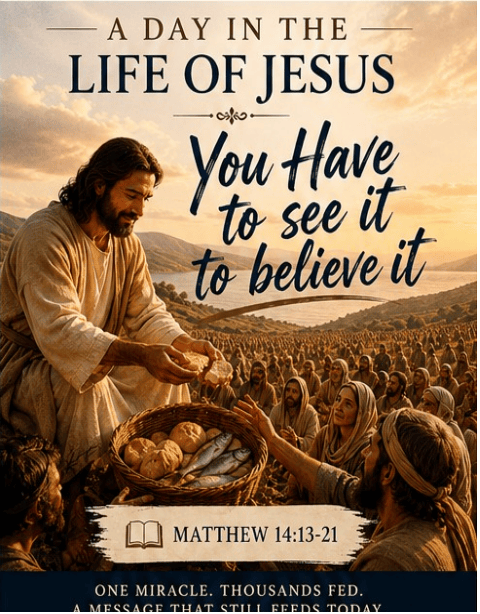
Chapter One
Sermon Title: You Had To See It To Believe It
Matthew 14:13–21
Scripture and Sermon
This morning we are beginning a new sermon series called “A Day in the Life of Jesus”. The
plan is to do a group of narrative messages that take us back to when the Lord walked this
earth and hopefully gain some perspective on what it was like. Today we will also receive the
Lord’s supper. You don’t have to be a member of our church to participate but this table is for
those who love the Lord. Let’s look now at Matthew 14:13-21. Hear the Word of the Lord.
     13 When Jesus heard what had happened, he withdrew by boat privately to a
      solitary place. Hearing of this, the crowds followed him on foot from the towns. 14
   When Jesus landed and saw a large crowd, he had compassion on them and healed
      their sick. 15 As evening approached, the disciples came to him and said, “This is a
    remote place, and it’s already getting late. Send the crowds away, so they can go
     to the villages and buy themselves some food.” 16 Jesus replied, “They do not need
     to go away. You give them something to eat.” 17 “We have here only five loaves of
    bread and two fish,” they answered. 18 “Bring them here to me,” he said. 19 And
    he directed the people to sit down on the grass. Taking the five loaves and the two
       fish and looking up to heaven, he gave thanks and broke the loaves. Then he gave
    them to the disciples, and the disciples gave them to the people. 20 They all ate
    and were satisfied, and the disciples picked up twelve basketfuls of broken pieces
     that were left over. 21 The number of those who ate was about five thousand men,
     besides women and children.
Hello my name is Andrew and I want to tell you about one of the greatest miracles of all! To
be honest, you had to see it to believe it.
It all began one morning while we were riding a mountain of momentum! Nobody in the
whole country was more popular than our Lord. People were coming from miles away to hear
him speak. The crowds were enormous and continuing to grow.
Life was good! That is how I remember the events that day the pastor just read.
But why is it when things are going so good something bad has to happen. That’s what
occurred. When life is at its best, tragedy strikes.
Jesus’ cousin and closest friend was senselessly murdered by Herod. I didn’t get all the details
but apparently John the Baptist upset the wrong lady. Herod’s wife did not take kindly to
being called out for her choices.
She had her daughter dance before Herod and then when he promised anything in the
kingdom, she asked for John’s head. It was so brutal and so typical of the times in which we
lived.
We got word first thing that morning and immediately could tell the Lord took the news hard.
Sometimes it is easy to think Jesus was immune from disappointment and heartache because
He is God.
But when they told him his cousin and dear friend had died a horrible death, He was
disturbed in his heart. You could see it on His face the anguish and pain.
Jesus understands tragedy. He experienced it.
It wasn’t the only tragic event that occurred in his life. The Prophet Isaiah said the coming
Messiah would be a man of sorrows. Jesus fit that bill. He had more than His share of awful
days.
Probably what upset him the most was how often tragedies are senseless.
John the Baptist didn’t deserve to die. He was spreading the good news about the kingdom of
God being at hand. People were confessing their sins and being forgiven.
He set the stage for the Lord’s coming and now he is gone.
John the Baptist might have been the only person who truly understood Jesus’ mission. He
knew what it was like to be popular and despised by the religious leaders.
Jesus lost more than a family member. He lost his confidante and friend.
It wasn’t surprising that when Jesus was hurting, He turned toward God. That was what He did
all the time.
So Jesus told us to gather our things to cross the lake to a deserted place where He could be
alone with God. His prayer time renewed his strength and gave him perspective and purpose.
So the plan was when we made shore we would set up camp while he headed for the
mountains.
But what none of us expected was how quickly the crowds followed us on foot. Before Jesus
could reach the crest of the hillside, he could see the massive multitude making their way
toward us.
He really should’ve kept on going, we could have distracted the crowd. We could have taught
them while the Lord grieved the passing of John.
But just like Jesus, even though he was hurting, he had compassion on the masses and
returned to our campsite.
Here is one lesson I had learned being with Jesus, He always put the people before His own
concerns.
Needless to say, the crowd was full of people with all types of sickness and disease. There
were people who were blind from birth, others crippled from accidents, and of course, there
were those who had an infectious disease called leprosy.
All waiting their turn to see Jesus. And even though he was heartbroken, He healed the sick. I
don’t know how He did it.
What is often not written about is how Jesus’ healing brought forth spontaneous praise. It
wasn’t just those who had been touched, it was everyone.
For the first time in a long time, we had hope. We felt like we belonged. It was like He created
a new community. There was singing and there were shouts of “Hallelujah” and “Praise the
Lord.” I wish you could have been there. It felt like heaven had settled on that hillside. It was
amazing.
The one thing that was always true is how quickly time passed as Jesus healed one person
after another. Often He would allow them to tell their stories. Jesus never rushed through the
healings. He never lined them up touching their foreheads one after another. Each person
mattered to Him and to God.
He didn’t just want to heal their bodies, He wanted to heal their hearts. Some were angry at
God and He wanted to restore their relationship. It was amazing.
Not surprising, the sun was beginning to set and we realized that he hadn’t eaten all day. Not
only that, but we hadn’t seen the crowd eat either.
Now I had secured some food from a little boy that would probably feed the Master and give
the rest of us a little snack. But there was no way this crowd could be satisfied. The best we
could tell, most of them left in such a hurry that morning that they hadn’t eaten as well.
So we asked Jesus to speak to us privately and we told Him that it would be a good time to
dismiss the crowd because they still were going to have to travel several miles to get to the
closest town to find food.
That’s when Jesus said something that stunned us. It wasn’t the first time, but this one was a
doozy. The Lord said, “You give them something to eat!”
I forgot who said it, but one of us blurted out, “It would take a half of a year’s worth of wages
to feed this crowd”. And he wasn’t lying. And besides we only had five loaves and two fishes.
Not really enough to feed our group.
That’s when he asked for the food and told us to put the people in groups of fifty. We found
this a strange request.
Jesus was never concerned about how many people were present at any of his meetings which
was a good thing because the crowds were so large.
But on this occasion, He knew it mattered for some reason and we began to organize the
groups. We segregated the people. We had all of the men gather in the front while we placed
the women and children in the back. It wasn’t that they didn’t matter but it just was the way
things were done in our day.
Needless to say, Matthew the accountant in the group, quickly counted the groupings and told
us that there were a hundred groups of fifty which equaled five thousand not counting women
and children, which meant each of us had to serve at least eight groups.
As we had gathered the groups together Jesus also wanted us to ask for baskets. Honestly
most of them came from the woman in the back, but surprisingly we had stacks of baskets
now several feet high that you really could hardly see Jesus who was behind them all.
Jesus put the bread in one basket and the two fish in another. Then we watched as Jesus
raised his arms toward heaven and thanked God for the provisions and thanked Him for what
He was able to do. And that was it.
But when we opened our eyes, the basket that had the bread was now overflowing and the
fish as well. It was the greatest miracle I had ever seen.
Jesus does the impossible. Where did the fish and bread come from? To this day, we don’t
know. It reminded us of God providing manna to the people of Israel in the wilderness.
So I was the first person to receive a basket full of fish and bread. And for reasons I can’t
understand, I found myself taking it toward those sitting in the back first. It didn’t sit well with
the men sitting up front. But I was reminded of Jesus’ words, “the last shall be first.”
Other disciples followed my cue. Needless to say, it took awhile to get to the very back. I was
a little worried that we might have a riot on our hands if only the women and children got fed
but I followed the voice inside me.
As I returned, I passed the other twelve on the path through the crowd. Surprisingly their
baskets were full as well. It made no sense. Jesus only had one basket full of fish and one
basket full of bread, yet He was making it multiply.
I picked up another basket and gave it to Jesus and once again he filled it to the brim. By this
time, we were beginning to feed the men once again from the back to the front.
There was an urgency in our step because we were hungry. I wanted so much to grab
something for myself. It took us about an hour to feed the groups.
Then we finally got to sit down to enjoy our own basketful of fish and bread. And the last one
was just as fresh as the first. It went down so well.
Needless to say, we have a few healthy eaters. (Peter and James just to name a few) They
devoured the fish in no time and grabbed another but there was plenty to go around.
It was a surreal atmosphere. I looked across that hillside. Nobody wanted to leave. Children
were laughing. Mothers were crying. Fathers stood silently looking toward Jesus. We all
knew.. We’d never experience another day quite like this one.
The miracle wasn’t in the bread, it was in the Presence of God. He was so real.
No one could doubt that it was a holy moment. Probably something like Moses experienced
on Mount Sinai.
Then someone began to sing something like this, “Holy, Holy, Holy, Lord God Almighty! Early
in the morning, our song shall rise to Thee”. Over five thousand people were worshipping the
Lord. With the sun setting over the mountain, this must be what heaven is like. We knew we
couldn’t stay. What a holy moment!
Jesus then instructed us that he wanted the leftovers kept. Why? We didn’t know because
none of us could eat another bite. So each of us took a basket and began to go through the
crowd picking up food not touched.
Amazingly each one of us returned with a basket full. Someone said just like there were
twelve tribes of Israel, we had a basketful of leftovers for each one. I don’t know about that.
All I did know is Jesus had provided more than enough!
You had to be there to believe it.
The greatest miracle that day wasn’t that Jesus multiplied bread. It was a grieving
Savior still found room in His heart for hurting people.
That day we thought Jesus fed thousands of people. Years later we realized He wasn’t just
feeding stomachs. He was revealing who He really was. The Bread of Life.
And He’s still feeding hungry people today. As we receive communion this morning, come and
partake of Jesus. As you receive the body and blood of our Lord Jesus Christ, may you
experience the healing of Jesus. Let’s stand.
For Reflection and Discussion
- The feeding of the five thousand begins with Jesus grieving the death of John the Baptist.
What does Jesus’ response teach you about bringing your own grief to God? - Jesus had compassion on the crowd even while He was hurting. How can compassion make
room for another person’s need without pretending our own pain is unimportant? - The disciples saw an impossible problem: thousands of hungry people and almost no food.
Where are you most tempted to focus on what you do not have rather than what Jesus can do? - Andrew could not explain exactly how the bread and fish multiplied. Why is it important to
distinguish between what Scripture tells us and what we imagine may have happened? - At the end of the day there was more than enough. Where have you experienced God’s
provision in a way you did not expect?
One Question to Carry With You
What am I placing in Jesus’ hands that looks too small to matter?
Behind the Sermon
I chose Andrew because he was the disciple connected to the loaves and fishes. At the time, I
did not realize how useful he would become for the rest of the series. I simply had that inward
“yes” in prayer.
first-person preaching did not lessen the need for expository preparation. It increased it. Once
I became Andrew, details that might have seemed insignificant became important. How many
baskets would be needed? Could the crowd actually see the bread multiplying? How would the
people be arranged? What would Andrew notice?
Some of those details are imagination. I wrestled especially with Andrew serving the women
and children first. When I preached the sermon, I softened that and had him serve those in the
back rather than claiming certainty Scripture does not give us. Peter and James being healthy
eaters is creative imagination too, but it does not carry theological significance.
That distinction matters. The authority of the sermon must remain in the text, not in my
imagination.
The main truth also emerged while I was writing and living inside the story. I still do the
normal expository work and identify biblical truths in the passage, but first-person preaching
has a way of making one truth rise above the others. Here, the miracle became more than
multiplication. I began seeing a grieving Savior who still had compassion for hurting people.
That is one of the gifts of first-person preaching: the character makes me look longer, ask
different questions, and sometimes discover the sermon while I am inside the story.
Give It a Try
Choose a familiar biblical story and identify someone in it who is not the obvious main
character. Read the passage several times through that person’s eyes.
Write down only what the text actually tells you. Then make a second list of details you can
reasonably imagine. Keep the two lists separate.
Ask: What would this person see? What would they hear? What would they know? What would
they not know? What emotions are reasonable?
Finally ask the most important question: If I removed every imagined detail, would the biblical
truth of my sermon still stand?
If the answer is yes, imagination is probably serving the text rather than replacing it.

